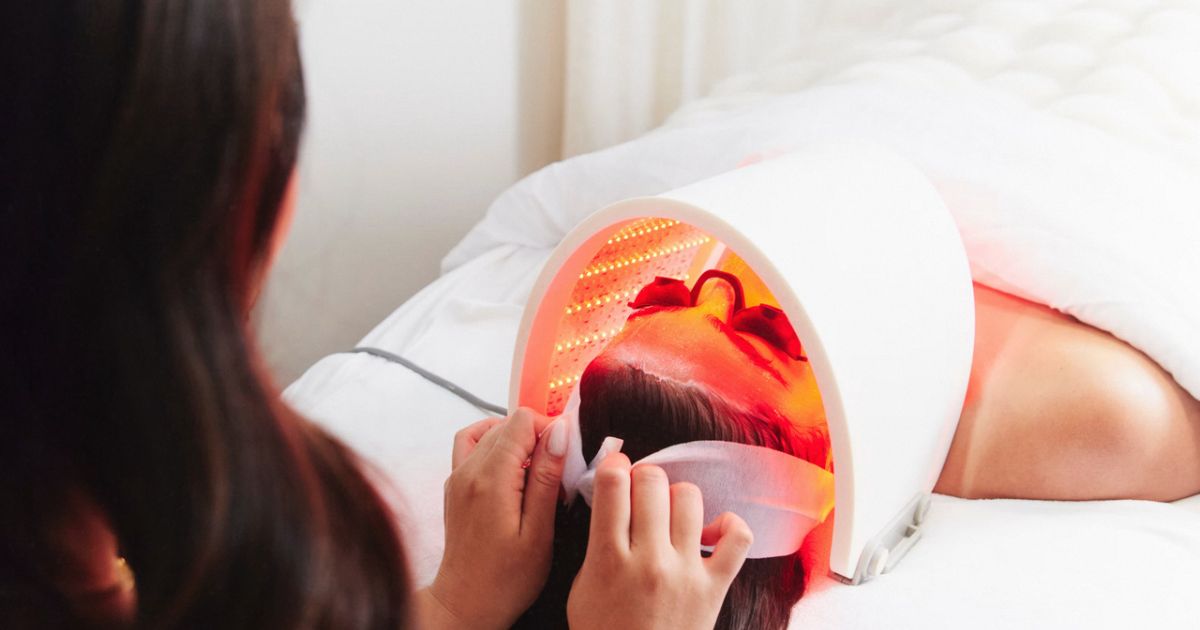
Yes, red light therapy can help mature skin, but think subtle, not snatched. Controlled studies using red light (around 630 to 660 nm) and near-infrared light (around 830 to 850 nm) show softer fine lines, smoother texture and more collagen after 8 to 16 weeks of consistent use. For the face, a mask is the easiest place to start. A panel makes sense if you also want neck, chest and body. It is a treatment, not a skincare step, so see a board-certified dermatologist first.
The question every woman over 40 is asking
A recent Reddit thread asked something simple: has anyone over 30 actually used red light therapy, and is a mask or a panel better for mature skin? The replies read like a group chat with your most honest friends.
A 60-year-old with rosacea said she has used a mask or a panel for three years alongside prescription creams, and that both calm her redness. A 50-year-old said she saw tighter skin within a month and still uses her mask daily, two years later. Others were more cautious. One woman used a mask and a panel five days a week for three months and called her before and afters negligible, although her breakouts and scrapes healed faster.
That mix is the real story. Red light therapy is not hype and not a miracle. It is a slow, consistent treatment with real science behind it, real limits, and a few safety rules you should not skip. Here is everything you need to know before you buy anything.
First things first: this is a treatment
Red light therapy is a treatment, not a skincare product. Before you buy a device, book an appointment with a board-certified dermatologist to make sure it is the right treatment for you.

Its medical name is photobiomodulation, and dermatologists use it in their offices for acne, signs of aging, hair loss and wound healing. The American Academy of Dermatology (AAD) recommends seeing a dermatologist before using red light at home, for three reasons:
- Results. A dermatologist can tell you whether red light is likely to improve your specific concern, before you spend $100 to more than $1,000 on a device.
- Your skin conditions. Some conditions, such as lupus, can get worse with light exposure.
- Your medications and treatments. Some medicines and prescription creams make skin more sensitive to light.
A dermatologist can also tell you whether something else would do more for your skin, such as a prescription retinoid, a peel or an in-office procedure. Often the best plan combines red light with other treatments rather than using it alone.
This article is editorial content, not medical advice. Use it to prepare good questions for your appointment.
Why your skin changes after 40
Collagen is the scaffolding that keeps skin firm and bouncy, and estrogen helps keep its production going. As estrogen drops around menopause, collagen loss speeds up. Research suggests skin can lose up to about 30% of its collagen in the first five years after menopause, then roughly 1 to 2% a year after that. That figure comes from small studies, but dermatologists still use it as a useful benchmark.
The result is what so many of us notice at once: thinner, drier skin, less bounce, crepey texture, and lines that stay after the smile is gone. Sunscreen protects the collagen you have, and retinoids help build more. Red light therapy is pitched as another tool for that rebuilding job.
What the science actually says
The short version: real benefits, modest size, slow timeline.
Red and near-infrared light are absorbed by the mitochondria, the energy centers inside your cells. The leading theory is that this extra energy pushes fibroblasts, the cells that make collagen and elastin, to work harder while calming inflammation. Unlike UV light, red light has not been shown to cause skin cancer.
The studies people cite most:
- 2007, 76 patients. A randomized, placebo-controlled, double-blind trial treated one side of the face with 633 nm, 830 nm or both, twice a week for four weeks. Wrinkles dropped by up to 36% and elasticity rose by up to 19%. Skin samples showed more collagen and elastic fibers.
- 2014, 136 volunteers. A randomized, controlled trial gave twice-weekly sessions for 30 sessions in total. Treated skin felt and looked smoother, and ultrasound measured higher collagen density.
- 2025, at-home masks. A double-blind trial compared a home mask using 630 nm and 850 nm light against a fake device. Crow’s feet improved significantly at 8, 12 and 16 weeks.
Now the caveats. The AAD describes results as subtle to noticeable. At-home devices are less powerful than the ones in a dermatologist’s office. Studies test different devices on different schedules, so they are hard to compare. Nobody yet knows the ideal dose, or the effects of using it for many years.
Set your expectations accordingly. Harvard dermatologist Dr. Rachel Reynolds says home devices need to be used multiple times a week for four to six months. Think softer lines, more even tone, less redness and a healthier glow. Do not expect a facelift in a box.
Mask vs. panel: which one fits your life
If your goal is your face, start with a mask. If you want face, neck, chest and body, a panel earns its space.
| Mask | Panel | |
|---|---|---|
| Best for | Face (some flip it for neck and chest) | Face, neck, chest and body |
| How you use it | Wear it, lie back, relax | Sit or stand at the distance in the manual |
| Dose | The same every session, since it sits against the skin | Changes with your distance and angle |
| Eye protection | Usually built-in shields or included goggles | Separate goggles, every session |
| Consistency | Easier, according to most Reddit users | Takes more setup |
The distance point matters more than it sounds. Light weakens as it travels, so a panel held too far away delivers less light than the label promises. A mask removes the guesswork, which is why one commenter called it more foolproof for beginners.
The thread’s consensus was clear: the best device is the one you will actually use, week after week, for months. Several women own both, using a mask most days and a panel a few times a week for the body.
The edit: devices the Reddit thread actually uses
These are the devices women in the thread named. We checked each one’s specs. Prices are US list prices as of October 2026 and change often, so check before you buy.
| Device | Format | Light | List price | Good to know |
|---|---|---|---|---|
| Omnilux Contour Face | Flexible mask | Red 633 nm, near-infrared 830 nm | $395 | FDA-cleared. 10-minute sessions, 3 to 5 times a week. Uses the same two wavelengths as the 2007 trial |
| Omnilux Men | Flexible mask | 633 nm, 830 nm, plus deep near-infrared 1072 nm | $395 | FDA-cleared for full-face wrinkles. The brand says women can use it too, which is why one 50-year-old in the thread chose it |
| CurrentBody Skin LED Mask Series 2 | Flexible mask | 633 nm, 830 nm, 1072 nm | $469.99 | FDA-cleared. 10-minute sessions. Separate neck and chest device available |
| Dr. Dennis Gross DRx SpectraLite FaceWare Pro | Rigid mask | Red, blue, or both | $455 | FDA-cleared. 3-minute sessions with automatic shutoff. The blue mode targets acne |
| Therabody TheraFace Mask Glo | Mask | Red, red plus infrared, blue | $379.99 | FDA-cleared. 12-minute sessions with a gentle scalp massage |
| Solawave Wrinkle Retreat Pro | Mask | 605, 630, 660 and 830 nm | $399 | FDA-cleared, according to the brand. One commenter pairs Solawave with its neck and chest device |
| Hooga PRO300 | Tabletop panel | Red 660 nm, near-infrared 850 nm | $299 | Covers face, neck and body. We could not confirm FDA clearance, so ask Hooga before buying if that matters to you |
Two shopping rules from the AAD. First, choose a device cleared for what you want to treat, which for most of us means wrinkles. Second, ignore the words “FDA approved” and “FDA certified” on a device. The FDA clears these devices, it does not approve or certify them.
How to use it
Once your dermatologist has given you the green light, these habits get you the most out of every session.
- Follow your device’s directions exactly. Session length and frequency differ by device, from 3 minutes daily to 10 minutes three to five times a week. More is not better. Longer or extra sessions will not speed up results.
- Start on clean, dry, bare skin. No serums, oils or makeup underneath unless the brand specifically says so.
- Take a before photo. Use the same spot, light and angle every four weeks. Changes are gradual and easy to miss in the mirror.
- Commit to at least 8 to 12 weeks before judging, and expect four to six months for the full picture.
- Keep wearing sunscreen every day. Red light does not protect against UV, and it does not replace SPF.
If you use retinol, retinal or tretinoin, read this carefully
Retinoids and red light can share a routine, but the order and the timing matter. Retinoids make skin more sensitive and easier to irritate, and some LED device makers list topical tretinoin as a photosensitizing ingredient.
- Never apply a retinoid before a session. That includes retinol, retinal, tretinoin, adapalene and tazarotene. The light always goes on clean, bare skin.
- Light first, retinoid after. Do your session, then apply your retinoid as part of your evening routine. Another option is red light in the morning and your retinoid at night.
- Prescription retinoids need a doctor’s OK. If you use tretinoin, adapalene or tazarotene, ask the doctor who prescribed it before you add red light, and follow their timing.
- Oral isotretinoin (Accutane) is a different case. It is a strong photosensitizer. Do not start red light therapy while taking it unless your dermatologist explicitly approves it.
- Introduce one thing at a time. If you are new to both, start one, let your skin adjust, then add the other. That way you know what is causing a reaction.
- Watch for warning signs. Stinging, burning, peeling or redness that does not fade means stop the light, let your skin recover and talk to your dermatologist. They may suggest alternating nights or adjusting your retinoid.
- Sunscreen the next morning is non-negotiable. Retinoid nights make your skin more sensitive to the sun.
Safety rules: do not skip these
Red light therapy is considered safe in the short term, and the most common side effects are mild, temporary irritation or discomfort. It is still a treatment, and these rules are not optional.
- See a board-certified dermatologist before you start. This is rule number one for a reason. They will check your skin, your conditions and your medications.
- Protect your eyes, every single session. Use the shields or goggles that come with your device, every time. Sunglasses are not a substitute. Never look directly into the LEDs. Be extra careful with blue light modes. In 2019, Neutrogena recalled its LED mask over eye safety concerns, and retinal damage has been reported in someone who used a blue LED mask without proper eye protection. If you have an eye condition, such as macular degeneration, ask your eye doctor first.
- Do not use it if you are light sensitive. That includes conditions like lupus, and anyone who blisters or burns easily in the sun.
- Check every medication. Some antibiotics, some blood pressure medications, oral isotretinoin and other drugs make skin more sensitive to light. Ask your doctor or pharmacist before you start, and again whenever you start a new medication.
- Melasma or darker skin? Talk to a dermatologist first. The AAD warns that darker skin tones are more sensitive to visible light, red light included, and this can cause dark spots that are stronger and last longer. The evidence on red light and melasma is mixed. No study shows it consistently makes melasma worse, but if you have spent years fading it, do not experiment alone. Harvard’s Dr. Reynolds suggests that people with darker skin start at lower doses.
- Pregnant, planning a pregnancy or breastfeeding? Wait and ask. Several manufacturers, including Omnilux, tell you not to use their devices because they have not been tested in pregnancy. Ask your OB-GYN.
- Buy an FDA-cleared device. Clearance means the FDA considers the device low risk. It does not prove the device works, and “FDA approved” is a meaningless claim for these devices.
- Stop if something feels wrong. Burning, pain, lasting redness, headaches or new dark spots mean stop and call your dermatologist.
- Remember what we do not know yet. Short-term safety data is reassuring, but long-term effects have not been studied. That is one more reason to follow the label and keep your dermatologist in the loop.
FAQ
How long does red light therapy take to work on mature skin?
In studies, people saw changes after 8 to 16 weeks of regular sessions. Harvard dermatologist Dr. Rachel Reynolds says at-home devices need to be used multiple times a week for four to six months. You also need ongoing maintenance sessions, because skin keeps aging.
Can I use a red light mask every day?
Only if your device’s directions say so. Some masks are designed for short daily sessions, while others recommend three to five sessions a week. Using a device more often than directed does not speed up results.
Does red light therapy make melasma worse?
The evidence is mixed. Red light is visible light, and visible light can trigger pigmentation, especially in darker skin tones. No study shows red light consistently worsens melasma, but if you have melasma, talk to a dermatologist before you start.
Can I use red light therapy on my neck and chest?
Yes. Many brands sell separate neck and chest devices, and panels cover larger areas. The neck and chest also show early signs of aging, so many women in the Reddit thread treat them too.
Can I use red light therapy with retinol or tretinoin?
Often yes, with the right order and your dermatologist’s OK. Never apply a retinoid before a session. Use the light on clean, bare skin first and apply your retinoid afterward, or keep them at different times of day. If your retinoid is a prescription, or if you take oral isotretinoin, ask your doctor before adding red light.
Is an at-home device as good as treatment at a dermatologist’s office?
No. In-office devices are more powerful and let dermatologists adjust the dose. At-home devices are designed for safe unsupervised use, so results are gentler. They work best for maintenance or as part of a plan your dermatologist builds.
Do I really need to see a dermatologist first?
Yes. Red light therapy is a treatment, and the AAD recommends a dermatologist visit before using it at home. A dermatologist can check whether it suits your skin, your health conditions and your medications, and whether another treatment would work better for you.
Sources
- Is red light therapy right for your skin?, American Academy of Dermatology
- Red light therapy for skin care, Harvard Health Publishing
- Lee et al., 2007, LED phototherapy for skin rejuvenation, Journal of Photochemistry and Photobiology B
- Wunsch and Matuschka, 2014, red and near-infrared light and collagen density, Photomedicine and Laser Surgery
- Home-use LED and IRED mask for crow’s feet, 2025, Medicine
- Skin ageing and menopause, Menopause International
- Perimenopause is in my derm rooms now, Dermatology Times
- Dermatologist says red light therapy has benefits, but some should avoid it, Cleveland Clinic via WBRZ